
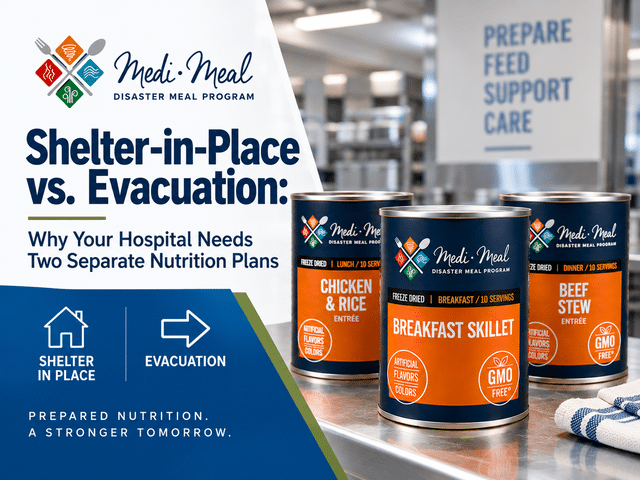
When hospitals prepare for emergency feeding, much of the attention naturally goes to food and water inventory.
But having emergency food in storage is only the beginning.
The bigger operational question is: Can your team actually feed patients and staff when normal operations are disrupted?
And the answer may be very different depending on whether your hospital is sheltering in place or evacuating.
A power outage, hurricane, fire, earthquake, burst pipe, or other emergency can affect kitchens, utilities, staffing, transportation, food deliveries, and access to different areas of the hospital. That’s why hospitals should think about emergency nutrition as an operational plan, not simply an emergency food supply.
One of the best ways to determine whether that plan works is to practice it with a mass-feeding exercise.
Shelter-in-Place: What Happens If Your Kitchen Isn’t Available?
During a shelter-in-place emergency, patients remain at the hospital while normal operations may be significantly disrupted.
Staff may also need to remain onsite. Deliveries could stop. The kitchen could become inaccessible or non-functional. Power or water could be limited.
Your emergency nutrition plan should answer practical questions such as:
- Where will food be prepared if the kitchen cannot be used?
- How many patients, staff, and others may need to be fed?
- Who will be responsible for preparing and distributing meals?
- What equipment and disposable serving supplies will be needed?
- How will hand hygiene and safe food handling be maintained?
- How will special patient diets be identified and distributed?
- Can staff outside the dietary department assist if necessary?
Practical Hospital Services’ Medi-Meal emergency meal program is designed specifically for healthcare emergency preparedness, including simplified preparation and long-term emergency food storage. Hospitals can also explore Acute Care Medi-Meal Kits designed for hospitals and larger healthcare facilities.
But even a well-designed emergency meal program needs something else: a staff that knows how to use it.
Evacuation Creates a Different Feeding Challenge
During an evacuation, the hospital faces a different set of circumstances.
Instead of feeding patients and staff in one location, patients may need to be moved to another hospital or designated care site. Food and water may need to accompany them, and transportation capacity may be limited.
An evacuation nutrition strategy should therefore consider:
- Portable food and water
- Rapid distribution
- Minimal preparation
- Dietary identification
- Food for accompanying staff
- Transportation and storage limitations
- Clear staff roles and responsibilities
Portable emergency foods, including MRE options, may be useful as part of the hospital’s broader emergency nutrition strategy.
Hospitals don’t necessarily need completely separate food inventories for shelter-in-place and evacuation. They do need to know what will be used, where it will be prepared, who will distribute it, and how the process changes under each scenario.
How Do You Know Your Emergency Feeding Plan Actually Works?
You practice it.
Practical Hospital Services has helped hospitals conduct mass-feeding exercises and developed a 3-step approach facilities can use to practice their emergency feeding response.
Step 1: Prepare for the Mass-Feeding Exercise
Start by choosing a realistic emergency scenario.
It could be a hurricane, fire, earthquake, tornado, burst pipe, extended power outage, or another event relevant to your facility.
Then determine what the exercise is designed to test.
For example, what happens if your kitchen becomes non-functional? Where will you establish an alternate feeding area? Which departments need to participate? Who is responsible for preparing food, distributing meals, managing supplies, and coordinating the response?
Preparation should include identifying the exercise objectives, assembling the team, establishing roles, selecting an alternate feeding location if necessary, and developing the workflow your team will follow.
Before the exercise begins, make sure participants understand the scenario, sequence of events, their assigned responsibilities, and where the feeding operation will take place.
Step 2: Run the Mass-Feeding Exercise
Now put the plan into action.
Team members should sign in and confirm their assigned roles. Before food preparation begins, verify that necessary equipment and supplies are available.
That includes more than food.
Depending on the exercise, your team may need gloves, sanitizer, hairnets, beard nets, aprons, trash cans, disposable cups, forks, containers, serving supplies, and other equipment necessary to establish a functioning emergency feeding area.
Then begin preparing and serving the food.
Observe the process as it happens.
Do staff understand their responsibilities? Can they find the supplies they need? Is the food preparation process easy to follow? Can meals be served on time? Does the workflow still make sense when people are operating outside their normal environment?
These are exactly the types of issues an exercise is supposed to uncover.
Step 3: Debrief, Learn and Improve
Don’t be afraid to perfect your mass-feeding exercise.
Your first exercise does not need to go flawlessly.
In fact, discovering problems during an exercise is valuable because you’re finding them before a real emergency, or a surveyor, puts the plan to the test.
After the exercise, gather the team for a debrief.
Discuss:
- What went well?
- What caused confusion?
- Were staff roles clear?
- Were any supplies missing?
- Did the alternate feeding location work?
- Could food be prepared and served efficiently?
- What would need to change during a real emergency?
Participant feedback can also provide valuable insight. Use what you learn to update the plan, communicate changes to the team, and improve the next exercise.
The objective isn’t simply to complete an annual exercise.
It’s to create a process your team becomes increasingly confident executing.
Emergency Preparedness Tip of the Day
We’re introducing our Emergency Preparedness Tip of the Day to provide healthcare facilities with practical ideas they can use to strengthen emergency readiness.
Today’s Tip: Don’t be afraid to practice, and perfect, your mass-feeding exercise.
Choose a realistic scenario and actually test what your team would do if normal foodservice operations were unavailable.
Don’t just talk through the plan around a conference table.
Assign roles. Set up the alternate feeding area. Gather the supplies. Prepare the food. Serve it. Then bring everyone together afterward and identify what worked and what needs improvement.
Every issue you discover during an exercise is one less surprise you may encounter during a real emergency.
Want to Run Your Own Mass-Feeding Exercise?
Practical Hospital Services has created a 3 Easy Steps to Running Your Own Emergency Mass Feeding Exercise guide to help healthcare facilities put these concepts into practice.
The eBook goes beyond the overview in this article with exercise planning guidance, sample scenarios, objectives, workflows, role assignments, supply considerations, checklists, feedback recommendations, and resources your team can use to build its own exercise.
Download the Free Emergency Mass Feeding Exercise eBook →
Planning ahead can save time, money, and stress and help your staff feel more confident when an emergency occurs.
To learn more about building an emergency food and water program for your facility, explore the Medi-Meal Program or contact Practical Hospital Services.