
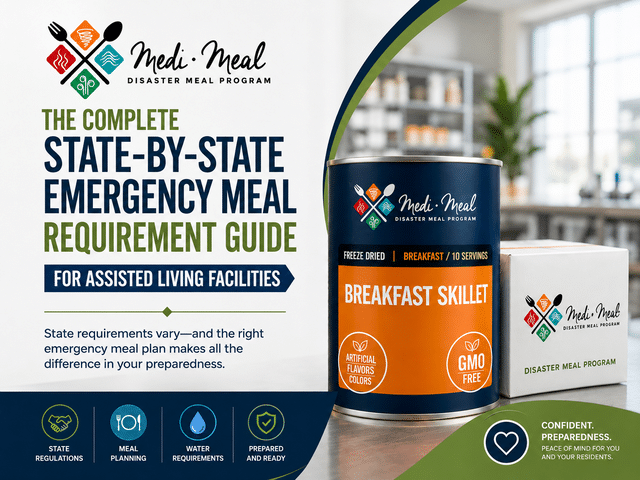
For assisted living administrators, Directors of Nursing, and Dietary Managers, emergency food planning is more than stocking canned goods in a storage room. Your facility needs a documented plan that accounts for residents, meals, water, dietary needs, staffing, storage, preparation, and the specific regulations that apply in your state.
The challenge is that assisted living emergency meal requirements by state are not uniform.
Some states establish a specific number of days of emergency food. Others specify nonperishable versus perishable inventory, water requirements, emergency menus, or broader disaster-preparedness standards.
That makes one question especially important:
How much emergency food and water does your assisted living facility actually need?
This guide explains where to start and how to calculate a safer, more defensible emergency supply.
1. Why State Regulations Vary—and Why It Matters
Unlike Medicare-certified nursing facilities, assisted living facilities are primarily regulated at the state level. There is no single federal assisted-living licensing standard establishing one emergency food quantity for every ALF in the United States.
That distinction matters.
An administrator operating communities in Alabama, Virginia, and New Hampshire, for example, cannot assume the same emergency inventory standard applies at every location.
Alabama requires enough food to provide three meals per resident per day for three days, along with sufficient nonperishable food and potable water for that period. Virginia requires availability of a 96-hour emergency food and drinking-water supply, with at least 48 hours of that supply on site. New Hampshire regulations for applicable residential-care facilities require three days of refrigerated food, seven days of nonperishable food, and three days of potable water.
The takeaway is simple: “We keep three days of food” is not a national compliance strategy.
Your emergency plan should start with the rules governing your specific facility type and location.
Practical Hospital Services recommends confirming applicable state and local requirements before establishing inventory levels. Its Medi-Meal emergency meal program is designed to help healthcare and assisted living organizations translate those requirements into an actionable emergency meal plan.
2. Federal Baseline vs. State-Specific Requirements
A common search is “CMS assisted living food requirements,” but the terminology can create confusion.
CMS does not directly regulate assisted living facilities as a general category in the same way it regulates Medicare- and Medicaid-certified nursing facilities. Assisted living licensing and operational requirements generally come from individual states.
Certain assisted living settings participating in Medicaid Home and Community-Based Services may also be affected by federal HCBS requirements, but those requirements should not be confused with a nationwide CMS rule requiring every assisted living facility to maintain a specific number of emergency meals.
For ALF operators, the more useful compliance hierarchy is:
- Determine your state licensing classification.
- Identify the emergency preparedness and food-service regulations applying to that classification.
- Check state and local emergency-management requirements.
- Determine whether additional Medicaid, contractual, accreditation, or organizational standards apply.
- Build inventory around the most demanding applicable requirement and your facility’s actual emergency plan.
3. State-by-State Emergency Meal Requirements
Because assisted living license categories and rules change, facilities should always verify requirements with their current state licensing agency. The following examples illustrate why a state-specific review is essential.
| State | Emergency Food Standard | Water/Additional Requirement |
| Alabama | 3 days; sufficient food for 3 meals per resident per day | Nonperishable food and potable water sufficient for the same period |
| Georgia | 3-day supply of nonperishable dry or canned foods | Emergency water must also be maintained |
| Missouri | 3-day food supply | Fresh water must be available |
| New Hampshire | 3 days refrigerated/perishable food plus 7 days nonperishable food for applicable residential-care settings | 3 days potable water; written management plan |
| Oklahoma | Food inventory sufficient to prepare menus for 3 days | Additional food-storage requirements apply |
| Virginia | 96-hour emergency food supply | 96 hours of drinking water; at least 48 hours of the supply must be on site |
What about the other states?
Requirements can depend on whether a facility is classified as assisted living, residential care, personal care, adult care, supportive living, or another state-defined category. Rather than relying on an outdated national chart, administrators should verify their current license category and regulation with the appropriate state agency.
This is especially important because regulations can change. A downloadable state-by-state reference should therefore function as a compliance starting point, not a substitute for current state regulations or legal guidance.
4. Common Emergency Food Survey Failures
The number of meals in storage is only one part of preparedness.
Facilities can run into problems when their written emergency plan says one thing while their physical inventory supports another.
Common weaknesses include:
- insufficient inventory for the documented census
- failing to account for staff who may shelter in place
- no reliable emergency water calculation
- expired or poorly rotated food
- inadequate storage documentation
- emergency menus that cannot support therapeutic or special dietary needs
- dependence on electricity or cooking equipment that may be unavailable
- missing documentation showing how inventory requirements were calculated and
- assuming normal food deliveries will continue during a disaster
Practical Hospital Services’ emergency planning resources emphasize determining who must be fed, what they will be fed, how frequently they will be fed, and how meals will be distributed.
That turns a storage inventory into an actual emergency feeding plan.
For more emergency-preparedness resources, visit Practical Hospital Services’ Safety & Emergency solutions.
5. How to Calculate Your Exact Emergency Food Supply
Once you know your state’s minimum requirement, calculate your actual need.
A simple starting formula is:
Residents × Meals Per Day × Required Days = Minimum Resident Meals
Consider an 80-resident assisted living facility subject to a three-day requirement:
80 residents × 3 meals × 3 days = 720 resident meals
But stopping at 720 could underestimate what the community needs during an actual emergency.
Administrators should also consider:
Staff. Will employees remain on site during a hurricane, blizzard, wildfire, flood, or extended utility outage?
Occupancy. Calculate against an appropriate census or capacity, not an unusually low census on the day inventory is checked.
Special diets. Residents may require texture-modified, therapeutic, allergy-conscious, or other specialized meals.
Water. Drinking water is only part of the equation. Some emergency foods require water for preparation, while sanitation and other critical operations can dramatically increase water demand.
Preparation. Could the meals still be prepared if natural gas, electricity, refrigeration, or normal kitchen equipment were unavailable?
Shelf life and rotation. A compliant emergency inventory can become expensive if products continually expire and require replacement.
Practical Hospital Services’ Community Medi-Meal Kits are specifically designed for assisted living and smaller healthcare facilities. Available programs use long-shelf-life emergency foods and packaged meal configurations to simplify emergency meal planning and reduce the burden associated with frequent inventory rotation.
Move From “We Have Food” to “We Have a Plan”
The most important lesson from reviewing assisted living emergency meal requirements by state is that compliance cannot be reduced to one universal number.
An assisted living 3-day food supply may satisfy the minimum food-duration requirement for some facilities, but another jurisdiction or license type may require something different. Your own emergency operations plan may also create needs beyond the regulatory minimum.
ALF Administrators, Directors of Nursing, and Dietary Managers should be able to answer five questions before the next emergency:
How many people are we feeding?
How many meals do we need?
How many days must we support them?
How much water will we require?
Can we execute the plan without normal utilities or deliveries?
If those numbers aren’t immediately available, now is the time to calculate them.
Calculate Your Facility’s Emergency Food Requirement
Don’t guess how many emergency meals your community needs.
Use the Medi-Meal Emergency Food Calculator to determine the emergency food supply your facility should plan for based on your population and preparedness requirements.
Use the Medi-Meal Emergency Food Calculator →
Practical Hospital Services’ Medi-Meal program provides long-shelf-life emergency meal solutions for assisted living communities, long-term care facilities, hospitals, and other healthcare organizations, helping facilities simplify storage, planning, preparation, and emergency food management.
Important: Emergency preparedness and assisted living regulations change and can vary by facility classification. Always verify current requirements with your state licensing agency and applicable local authorities before making compliance decisions.